
What the US-Iran conflict means for investors
After a choppy start to the year for the stock market, investors are now faced with another challenge to overcome in the form of geopolitical conflict, with the US and Israel launching a series of heavy air strikes on Iran and eliminating much of the country’s leadership. We will leave the judgement and commentary on the merits of this attack to the newspapers and cable networks.
The question we face is – what is the best strategy for long-term investors to navigate this situation? As of this writing, the S&P 500 is modestly negative in the opening minutes of trading after the attack (-0.3%).
#1 – Don’t sell stocks
The world is a complicated place filled with perpetual uncertainty about the future. War, disease, inflation, and recessions have been ongoing challenges for centuries. In this business, the only certainty is uncertainty. There is always a reason to sell stocks or change course on your investment strategy.
This is why there is a so-called “risk premium” in the stock market. There are enough investors that simply cannot stomach the volatility during periods of stress. This dynamic keeps a lid on asset prices most of the time. For those who are willing and able to tolerate volatility, they are rewarded with higher long-term returns.
Many strategists have hailed the post-Cold War period as one that has benefitted from the “Peace Dividend” – no major world wars among global superpowers has allowed globalization to thrive and multinational companies to prosper. While there is truth to this idiom, the last 35 years have been anything but calm.
Since the USSR was dissolved in 1991, investors have been faced with an internet bubble, the largest terrorist attack on US soil in history, two long and costly wars in the Middle East, a housing market crash, the Great Financial Crisis, war in Europe, Brexit, COVID, the largest inflation shock in 50 years, and a long list of additional smaller geopolitical conflicts.
During this 35 year period, there have been 17 corrections of -10% or more in the S&P 500 (roughly once every 2 years). However, investors who stayed the course were rewarded with average annual returns of +11.2% per year.
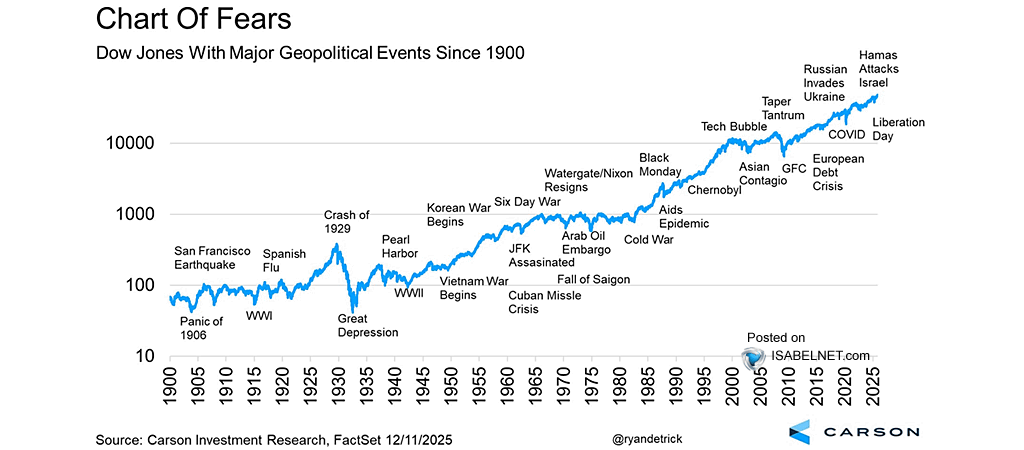
Over the last 100 years, investors have been faced with geopolitical conflicts regularly, and the stock market has continued to march higher:
More specifically, how do stocks behave in the months after a major negative global event? 65% of the time, stocks are higher a year later with a median return of +7.4% (slightly below average but still higher than cash or Treasury bonds).
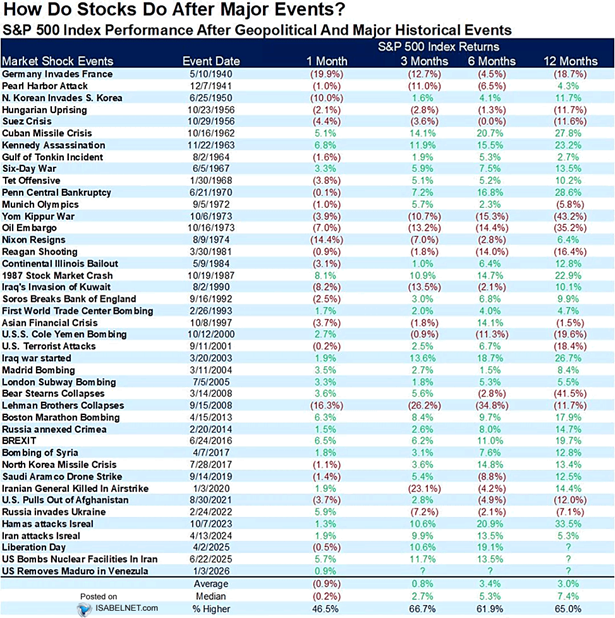
Source: Carson Investment Research, S&P Dow Jones Indices, as of 2/20/2026
Some will say “this time is different”. Others will say those are the four most dangerous words in investing. Investors are concerned about the impact to oil markets and global supply chains, both of which can put upward pressure on inflation. 18% of global air freight capacity has been taken out of the market this weekend, and 20% of the world’s oil travels through the Strait of Hormuz which sits at Iran’s Southern border.
While we expect short-term supply disruptions to have an impact on prices over the next several weeks, it is noteworthy that today’s oil price spike (+7.8%) is “only” the 38th largest spike in oil prices since 1990 according to Bloomberg and Deutsche Bank. This has happened before.
#2 – Maintain diversification
Many investors have wondered if diversification still works after a period of dominance from the S&P 500. Any deviation from the S&P 500, and more specifically the US mega cap tech stocks, has likely lowered returns for investors over the last 15 years.
Periods such as this remind us why diversifying across asset classes, sectors, and regions can help smooth the ride. As of this writing, the energy sector (which was largely abandoned by the investment community over the last decade) is the only sector in positive territory today (+1.5%). Oil prices are spiking and other safe havens such as gold (+1.3%) and the US dollar (+0.9%) are rallying.
As the economy has transitioned from a goods/manufacturing-based economy 50 years ago to a predominantly services-based economy, the stock market has reflected this shift. The 3 largest sectors in the S&P 500 are all services sectors – technology, financials, and communication services. However, the world still needs goods and commodities.
While we are big believers in tech and innovation, and still hold the view that the most innovative companies will be the market leaders for the next several decades, we have not abandoned “old economy” companies that shine during these types of periods. Maintaining some balance and discipline is rewarded when volatility strikes.
Additionally, the use of diversifying hedge funds that can profit from changes in commodity prices, currency fluctuations, and interest rate moves often perform well during these periods.
#3 – Look for opportunities
Our primary concern as humans is the well being of US service members, US citizens abroad, and innocent lives of people living in close proximity to danger in the Middle East.
However, as investors, our job is to participate in the game that is being played on the field, not the one we wish was being played. While we all hope for a peaceful world free of conflict, we continue to assess opportunities to deploy capital into companies that are creating goods and services that are vital to the world we live in today.
In the venture capital arena, we have backed several of the most innovative companies in aerospace & defense, energy & electricity, semiconductors, artificial intelligence, cybersecurity, public safety, and supply chains & manufacturing. We partner with the best venture capitalists in the world to find and back these companies. In the public markets, we own several of the incumbent market leaders in most of these categories as well.
While enterprise and consumer AI has (rightfully) dominated the market discussion over the last few years, we believe that those who find and partner with great businesses in these mission critical sectors will be rewarded.
